
Harrison County Court Records After Arrest
The court record after a Harrison County jail arrest is not the same thing as the booking record. The Sheriff's Office creates the jail record after arrest and intake. The magistrate step follows Texas Code of Criminal Procedure Article 15.17, which requires the person to be taken before a magistrate without unnecessary delay, generally no later than 48 hours. The prosecutor then decides what charge to file, amend, reject, or present to a grand jury. Once filed, the clerk-maintained case becomes the public court record unless a limit applies.
Use Harrison County jail inmate records to verify current custody, booking charges, bond clues, and local housing. Use court records after a jail arrest to follow the case after booking. Booking photos and public-photo questions belong with Harrison County jail mugshots, while filed charges, hearings, court dates, judgments, and dispositions belong in the court and clerk record.
Find Harrison County Court Records
The official public-access environment for Harrison County court and jail searches is Tyler Public Access. Research reached an AWS WAF human-verification page in the Tyler environment, so the live court-search fields were not captured. Do not assume the portal offers a specific name, case number, date, citation, warrant, or party-search field until a browser session shows it. The correct approach is to complete any human-verification step and follow the current labels on the live portal.
The broader Tyler Public Access landing page was captured from the official Harrison County portal source.
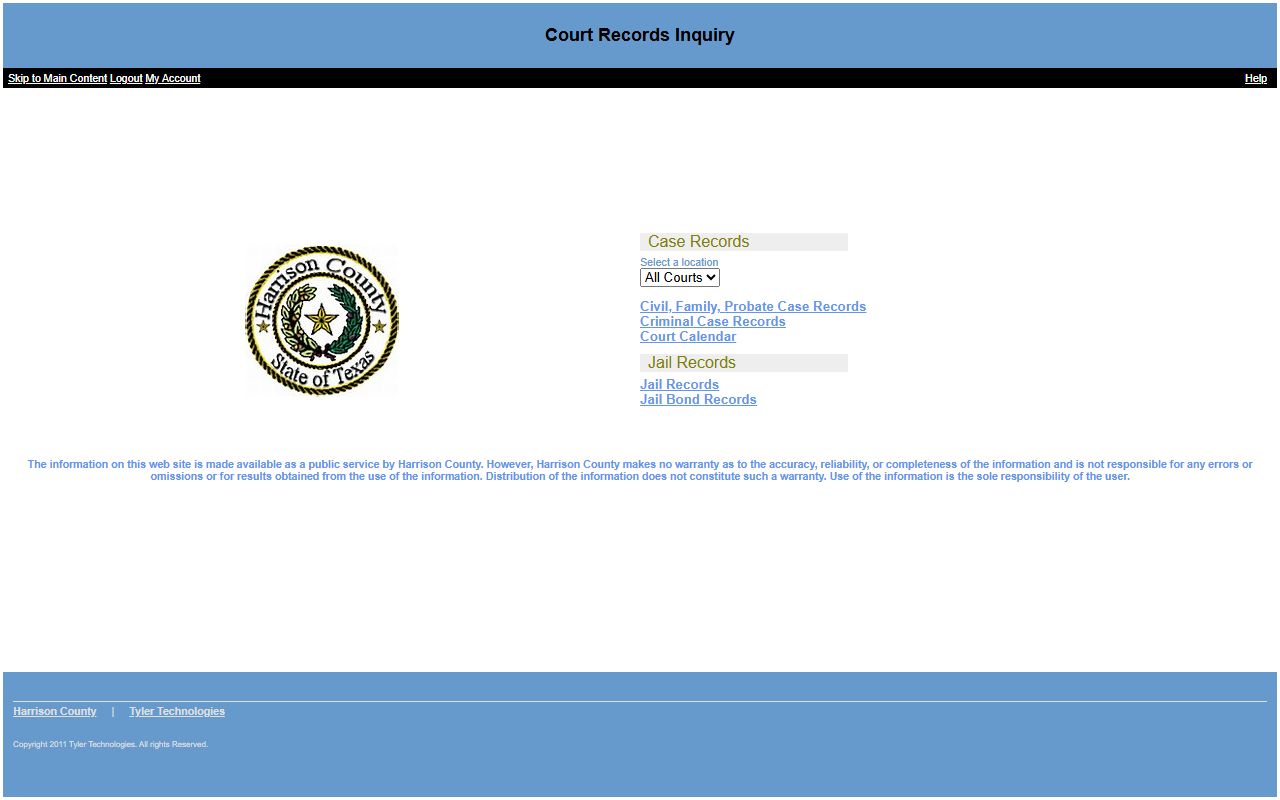
The image shows why court records after a jail arrest should be paired with clerk and phone routing when Tyler access is interrupted.
| Field Label | Type | Required | Options / Format Notes |
|---|---|---|---|
| Not captured | Not captured | Not captured | Tyler PublicAccess returned AWS WAF human verification during research. Manual portal inspection is needed. |
Search Court Records After Arrest
A court records after arrest search works best when the booking and court sides are compared instead of blended. Jail records may show arrest charges quickly, while prosecutor-filed charges may appear later or under a different wording. A no-result court search may mean the case is not filed yet, is filed in a different court level, or is not public online.
- Search the Harrison County Inmate Search for the booking, name, arrest date, charge wording, arresting agency, and any visible bond or warrant note.
- Open Tyler Public Access and search the court side using the fields the live portal provides.
- If the case is felony-level, check District Clerk routing and the District Attorney context.
- If the case is misdemeanor or county-level, check County Clerk and County Court at Law routing.
- Compare each filed court charge with the jail booking charge because the wording, level, and count can change.
Older, sealed, expunged, juvenile, and not-online records may need clerk contact or a public-information request. Court records are not a substitute for legal advice, and warrant or bond status should be confirmed with the issuing court, the clerk, or counsel.
Harrison County Court Routing
Harrison County has several local offices that may touch a criminal case after arrest. The District Clerk is the routing point for district-level case records. The County Clerk is the county-level records path. The County Court at Law provides county court context, and the District Attorney evaluates criminal allegations and files, rejects, amends, or presents charges depending on the case.
| Office or Channel | Use It For | Known Contact |
|---|---|---|
| District Clerk | District and felony case routing. | 903-935-8409 |
| County Clerk | County-level records routing. | 903-935-8403 |
| County Court at Law | County court criminal and civil context. | 903-935-8406 |
| District Attorney | Prosecutor filing and charge-review context. | 903-935-8408 |
| Civil & Warrants | Warrant and civil-process routing. | 903-923-4002 |
Harrison County Charging Documents
Court records after a Harrison County arrest often turn on the charging document. A complaint may support probable cause or begin an early case stage. An information is a prosecutor-filed charge often used for many misdemeanors and some waived-indictment situations. An indictment is a grand-jury charging document for felony prosecution unless indictment is waived where Texas law allows.
| Document | Who Creates It | What It Means |
|---|---|---|
| Complaint | Officer or prosecutor | Early charging or probable-cause document often used around arrest or misdemeanor processes. |
| Information | Prosecutor | Formal prosecutor-filed charge, common in many misdemeanor cases and some waived-indictment settings. |
| Indictment | Grand jury | Felony charging document showing a grand jury found enough basis to charge. |
These documents explain why jail charges and court charges may not match. A booking charge is an arrest label. The prosecutor can file a different charge, add counts, reduce the level, reject the charge, or seek indictment later.
Harrison County Charge Status
Charge status tells where a court record stands after a jail arrest. A pending charge is unresolved. An amended charge has changed in wording, count, or level. A reduced charge is lowered to a lesser offense. A dismissal ends that count without conviction. A no-bill means the grand jury declined indictment. A conviction follows a plea, verdict, or other adjudication. Deferred adjudication is a Texas court-supervision outcome that is not the same as a straight conviction, though it can still appear unless later sealed or cleared.
| Status | Plain Meaning | Why It Matters |
|---|---|---|
| Pending | The case or count is open. | Do not treat it as a conviction. |
| Amended | Charge wording, level, or count changed. | Use the newest court entry, not the first jail charge. |
| Reduced | The filed charge moved to a lesser offense. | Bond, plea, and sentencing exposure may change. |
| Dismissed | The count ended without conviction. | Check whether expunction or sealing may be available. |
| No-billed | The grand jury declined indictment. | The felony path may stop unless another charge is filed. |
| Convicted | Guilt or adjudication was entered. | Check sentence terms, custody, and appeal or supervision status. |
Bond Records After Arrest
Bond entries connect jail custody with the court record. Texas Code of Criminal Procedure Chapter 17 governs bail, personal bonds, bond conditions, and related release rules. Harrison County lists Jail Bonds & Fines at 903-923-4004, and the sheriff page links the Harrison County Bail Bond Board and approved licensed bonding companies. Use those official local channels instead of commercial bond lists when confirming release options.
| Bond Type | Practical Meaning | Check Before Paying |
|---|---|---|
| Cash bond | Full cash amount paid as directed by the jail, clerk, or court. | Payment location, accepted method, and release conditions. |
| Surety bond | Licensed bonding company posts bond for a fee. | Company licensing and any added court conditions. |
| Personal or PR bond | Release on promise and conditions without full cash deposit. | Court approval and reporting terms. |
| No-bond hold | A judge, warrant, parole, federal, ICE, or other hold blocks release on that item. | Whether every hold has been cleared. |
A local bond does not always release a person. Out-of-county warrants, parole holds, federal holds, ICE detainers, and other active cases can keep a person in custody after one Harrison County bond is posted.
Harrison County Warrants After Arrest
No separate official Harrison County public warrant-search page was located beyond the sheriff and Tyler public-access environment. The county contact directory lists Civil & Warrants at 903-923-4002. A warrant arrest may appear first as a jail booking and then as a court entry tied to a case, bench warrant, capias, or hold. Warrant status should be confirmed with the issuing court, the clerk, counsel, or the sheriff's warrant unit.
- Arrest warrant
- A judge-authorized arrest order tied to a criminal allegation.
- Bench warrant or capias
- A court warrant often issued after failure to appear or violation of a court order.
- Search warrant
- An order authorizing a search, not automatically a custody record.
- Fugitive warrant
- An out-of-county or out-of-state warrant that may create a hold.
Charges and Convictions
A charge is an accusation or filed count. A conviction is an outcome after plea, verdict, or other adjudication. Court records after a jail arrest may show both, but the two should never be treated as the same. This distinction matters for bond, employment questions, housing questions, reputation, and any later record-clearing analysis.
| Point | Charge | Conviction |
|---|---|---|
| Stage | Accusation or filed count. | Final or adjudicated outcome. |
| Proof | May begin with probable cause or prosecutor filing. | Requires plea, verdict, or adjudication. |
| Result | Can be amended, reduced, dismissed, or no-billed. | May lead to sentence, supervision, fine, or custody. |
Sealed and Expunged Records
Public access is not unlimited. Texas Code of Criminal Procedure Chapter 55 governs expunction, which is the court process for removing qualifying arrest records. Texas Government Code Chapter 411 governs criminal-history record information and limits some dissemination. Juvenile records, sealed cases, medical records, victim information, active-investigation material, and expunged records may be withheld from public view.
| Record Limit | Effect | Plain-English Caution |
|---|---|---|
| Sealed | Public access is restricted by court order or law. | Some government access may remain depending on the order. |
| Expunged | Qualifying arrest records are removed or treated as not existing for many purposes. | Eligibility depends on the case result and Texas law. |
| Confidential by law | The clerk or agency may withhold the record. | Juvenile, medical, victim, and protected data may not be public. |
State Criminal History
Texas DPS criminal-history systems operate under Government Code Chapter 411 and are different from Harrison County court records after a jail arrest. A local court file follows a specific case. A statewide criminal-history lookup may show broader history and may involve separate fees, rules, and permissions. Use the local court and clerk record to verify what happened in a Harrison County case, then use state criminal-history channels only when a broader Texas history check is the lawful and proper route.
Important: Public court and jail lookups are not consumer reports and cannot be used for FCRA-covered screening decisions.